

VR training delivers measurable return on investment for organizations that implement it with the right infrastructure behind it. The evidence is consistent across industries: faster skill acquisition, lower operational costs, and higher knowledge retention than classroom or video-based methods. The gap between programs that prove ROI and those that can't isn't the training itself — it's whether the organization has the tools to measure what's happening across its fleet. ArborXR Insights closes that gap.
Does VR Training Actually Deliver Positive ROI?
Yes. VR training produces strong ROI when the program is structured to capture it. The business case rests on three compounding advantages: trainees learn faster, retain more, and organizations eliminate the operational overhead that makes traditional training expensive at scale. Each of these advantages is quantifiable — and together they consistently outpace the upfront investment in hardware, content, and management infrastructure.
How Much Faster Do Employees Learn With VR Training?
VR training accelerates skill acquisition by placing employees in realistic, hands-on scenarios rather than passive instruction formats. The learning compression is significant. A PwC study found that VR learners completed training four times faster than classroom learners on average. Smooth Soft, a VR training provider for quick service restaurants, reduced new hire onboarding from 30–40 hours down to 3–6 hours by deploying through ArborXR's device management platform. Faster training means less time away from production — and that time savings compounds across every cohort a program runs.
Does VR Training Actually Improve Knowledge Retention?
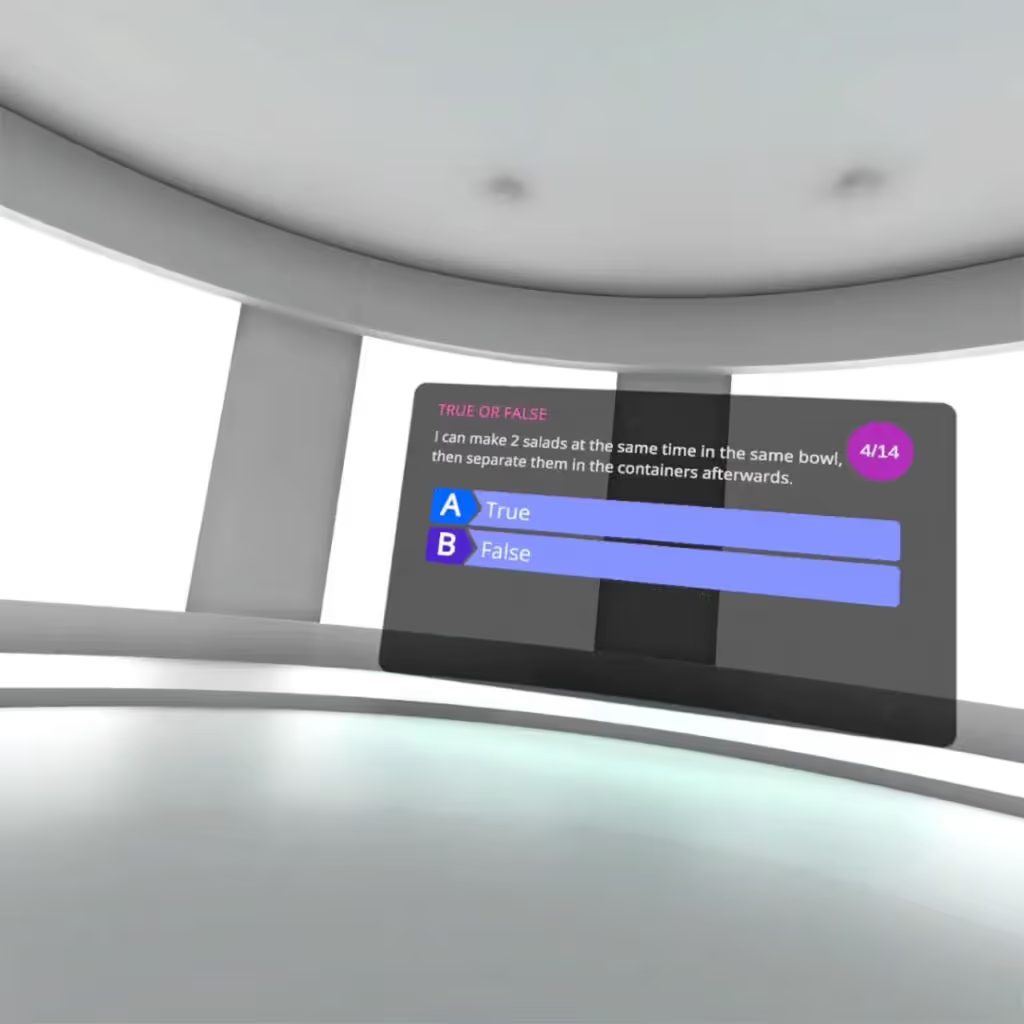
VR training produces higher retention than desktop or lecture-based formats because the multi-sensory experience encodes information more deeply into long-term memory. A University of Maryland study found recall accuracy of 84% for VR learners versus 75% for learners using a desktop display. Higher retention translates directly to job performance: employees who remember more of their training make fewer errors, produce higher quality work, and require less remedial instruction. That performance lift is one of the most durable ROI drivers in a well-run VR program.
What Operational Costs Does VR Training Eliminate?
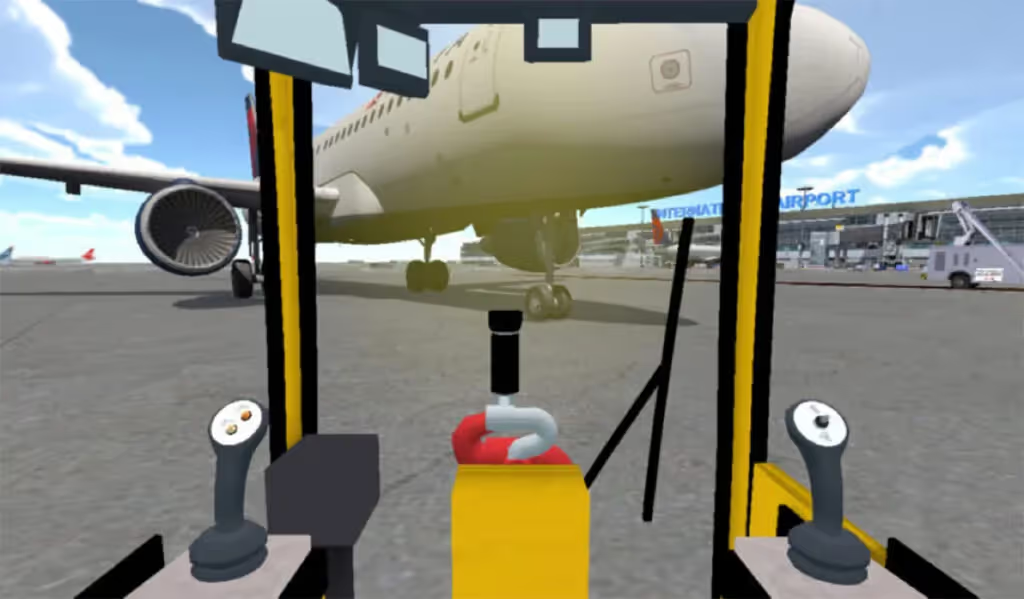
VR training removes the recurring costs that make traditional training expensive to run at scale: travel, instructor fees, venue rentals, and physical equipment wear. It also reduces the cost of risk. Delta Air Lines, working with Futurus and ArborXR, virtualized its aircraft deicing training program — cutting fluid usage and eliminating significant trainer and employee travel expenses. For programs where real-world practice carries safety risk, the avoided-incident value alone can justify the investment.
Can VR Training Scale Across a Distributed Workforce?
Yes, and scalability is one of VR's clearest structural advantages over traditional methods. Cloud-based XR management platforms like ArborXR deploy standardized content to hundreds of headsets without requiring local IT support at each site. Device management, software updates, and content versioning are handled centrally — which means L&D teams spend time building effective programs, not managing hardware logistics. Organizations scaling from pilot to enterprise deployment don't face a proportional increase in administrative overhead when the management infrastructure is in place from the start.
What Does VR Training Actually Cost?
VR training costs vary by program size and content approach, but the primary cost categories are consistent across deployments.
Hardware runs from $300–$700 per unit for entry-level headsets (Meta Quest 3S at approximately $299) to $1,200 and above for enterprise-grade devices (Lenovo ThinkReality VRX at approximately $1,200). Factor in accessories, maintenance cycles, and planned replacement as technology evolves.
Content splits into two tiers. Off-the-shelf modules — safety simulations, customer service scenarios — range from $5,000–$20,000. Custom content built for your specific workflows runs $30,000–$150,000 or more. Most organizations start with pre-built content and invest in custom development once baseline ROI is established.
Device and content management runs $10–$30 per device per month depending on fleet size and feature requirements. This covers content distribution, remote device monitoring, user administration, and kiosk mode controls.
Deployment and onboarding costs depend on IT complexity and whether staff need orientation to the hardware. ArborXR's platform is designed to minimize this ramp.
Hidden costs to plan for: periodic content updates as regulations or procedures change, device repairs, and replacement planning for attrition.
How Do You Calculate the ROI of a VR Training Program?
ROI is calculated by comparing total program costs against quantified benefits using a straightforward formula. Capturing the right inputs on both sides is what most programs get wrong.
Step 1 — Calculate total costs. Sum hardware, content, management platform fees, deployment, onboarding, and ongoing maintenance. Include content update cycles and planned device replacement.
Step 2 — Quantify benefits. Measure time savings from faster training completion, reduced travel and instructor costs, productivity gains from higher retention, and avoided incident costs where safety training applies. ArborXR Insights gives fleet operators the usage data, completion rates, and performance metrics needed to quantify these benefits accurately — without it, Step 2 relies on estimation rather than evidence.
Step 3 — Apply the formula. ROI = (Benefits − Costs) / Costs × 100. A program that costs $100,000 and generates $150,000 in measurable benefits returns 50% ROI — $1.50 per dollar invested.
The organizations that demonstrate ROI consistently are the ones that instrument their programs from the start. Measurement infrastructure isn't a reporting add-on. It's what makes the business case defensible when it's time to expand the program.
Frequently Asked Questions
What is a realistic ROI timeline for a VR training program?
Most organizations begin to see measurable ROI within the first 12–18 months of deployment, with the strongest returns appearing as cohort volume increases. The upfront costs — hardware, content development, and platform setup — are largely fixed, so ROI improves as the same infrastructure serves more learners. Programs with high training frequency or large distributed workforces tend to reach positive ROI faster than low-volume deployments. See how Mars Wrigley achieved a $19M impact with VR training for a real-world ROI timeline reference.
What data do you need to measure VR training ROI accurately?
Accurate ROI measurement requires four data inputs: total program costs, training completion rates, time-to-competency compared to a prior baseline, and performance outcomes post-training. ArborXR Insights surfaces completion rates, session duration, and device usage data across the fleet, giving L&D and operations teams the evidence base they need to build a defensible ROI case rather than relying on estimates.
How does VR training ROI compare to e-learning or classroom training?
VR training carries higher upfront costs than e-learning but typically outperforms both e-learning and classroom formats on retention and time-to-competency metrics. The PwC benchmark of four times faster completion than classroom training is the most cited reference point. For high-stakes or procedurally complex training — safety, equipment operation, clinical skills — the retention and error-reduction advantages tend to produce stronger long-term ROI than lower-cost formats.
Does VR training ROI hold at small fleet sizes, or only at enterprise scale?
VR training ROI is achievable at smaller fleet sizes when content costs are managed through off-the-shelf modules and hardware is right-sized to the use case. The economics improve significantly at scale because fixed costs — content development, platform setup, IT integration — are spread across a larger training volume. Organizations running pilots on 10–25 devices should plan for a longer ROI horizon than enterprise deployments, but the structural advantages remain. See why XR training programs get stuck in pilot for the common barriers and how to move past them.
What role does device management play in VR training ROI?
Device management is an operational cost multiplier in either direction. Poorly managed fleets — with inconsistent software versions, manual update processes, and no central monitoring — add hidden labor costs that erode ROI. A purpose-built XR management platform like ArborXR eliminates those costs by centralizing content deployment, device health monitoring, and user administration. The platform cost ($10–$30 per device per month) is typically offset by the reduction in IT support overhead alone, before accounting for the training efficiency gains.
Can VR training ROI be demonstrated to executives without technical XR knowledge?
Yes, and this is where measurement infrastructure matters most. Executives evaluate training ROI through business outcomes — reduced incident rates, faster time-to-productivity, lower cost per trained employee — not headset specifications. ArborXR Insights translates fleet-level usage data into the output metrics that map to those outcomes. The programs that win continued executive support are the ones that show up to the review with numbers, not anecdotes.
What is the biggest risk to VR training ROI?
The most common ROI failure mode is a content-hardware investment without a management and measurement layer. Organizations that purchase headsets and commission content but deploy without a platform to manage the fleet and track outcomes end up unable to demonstrate the value they've created. Device drift, inconsistent content versions, and no completion data make it impossible to build a credible ROI case. Starting with the right infrastructure — including ArborXR Insights for measurement — is what separates programs that scale from programs that stall.
The teams running the best XR programs share one thing: they stopped improvising infrastructure and started managing it intentionally. See how ArborXR supports that shift at arborxr.com/explore.